
Interjections, Conjunctions, and Common Mistakes.
- Project director: MA. in ELT. Cesar Jaimes Jaimes/Hernandez Torres Sheyla Janeth, Seberino Mondragón Yareth.

- 15 feb 2021
- 3 Min. de lectura
Actualizado: 8 abr 2021
(February 15, 2021)
INTERJECTIONS
An interjection is a word added to a sentence to convey an emotion or a sentiment such as surprise, disgust, joy, excitement, or enthusiasm. Interjections are words used to express strong feeling or sudden emotion. They are included in a sentence (usually at the start). An interjection is not grammatically related to any other part of the sentence.


Examples of interjections

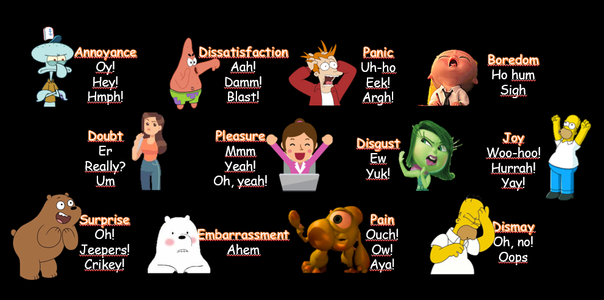
Yes and No
Expressions such as "yes," "no," "indeed," and "well" are often used as interjections.
For example:
Indeed, this is not the first time the stand has collapsed.
Yes, I do intend to cover the bet.
Phew!
Some interjections are sounds.
For example:
Phew! I am not trying that again.
Humph! I knew that last week.
Mmmm, my compliments to the chef.
Multi-word Interjections
Some interjections are more than one word.
For example:
Oh, really? I doubt that.
Holy moly! She won!
They're not always at the start of a sentence.
For example:
It is cold, indeed.
Common grammatical mistakes
Usually no errors are associated with interjections because they are isolated expressions and are preceded by a sentence.
Interjections do use an exclamatory sign after them.
Interjections of happy emotions should represent happy events and vice versa.


For more information.... Watch this video and enjoy it! ;)
CONJUNCTIONS.
A conjunction is a part of speech that is used to connect words, phrases, clauses, or sentences. Conjunctions are considered to be invariable grammar particle, and they may or may not stand between items they conjoin.
Types of Conjunctions
1.Subordinating conjunctions: Also known as subordinators, these conjunctions join dependent clauses to independent clauses. Common examples are "although," "because," "if," "since," "unless," "until," and "while."


2. Coordinating conjunction: Also known as coordinators, these conjunctions coordinate or join two or more sentences, main clauses, words, or other parts of speech which are of the same syntactic importance. The most common ones are "and," "but," and "or." There are seven in total: "for," "and," "nor," "but," "or," "yet," and "so." (You can remember them using the mnemonic F.A.N.B.O.Y.S.).

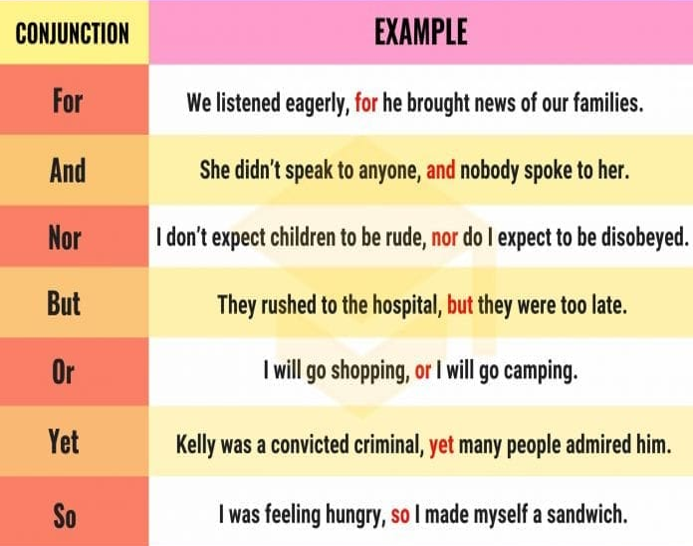
3. Correlative conjunction : These conjunctions correlate, working in pairs to join phrases or words that carry equal importance within a sentence.


Differences between conjunctions


Common gramatical mitakes
One conjunction for two clauses
In English, we use just one conjunction to connect two clauses.
Incorrect: Because he is intelligent so he gets good marks.
Correct: Because he is intelligent he gets good marks. OR He is intelligent so he gets good marks.
Because is a conjunction and English does not require a second conjunction.
Incorrect: Since he was angry therefore I said nothing.
Correct: Since he was angry I said nothing. OR He was angry; therefore, I said nothing.
Since is a conjunction and it is enough to join the two clauses: He was angry and I said nothing.
Because is a subordinating conjunction and must never be separated from its main clause by a full stop.
This is a common punctuation mistake.
(Incorrect): She did not come to school. Because she was ill.
(Correct): She did not come to school because she was ill.
But is the conjunction to use when the second main clause gives unexpected information.
(Incorrect): Their front door was open and there was nobody at home. (Correct): Their front door was open but there was nobody at home.
For more information.... Watch this video and enjoy it! ;)
Teaching Grammar Method
For this class we will be going through two methods, the grammatical translation method and the audio lingual method. These methods were chosen since we intend to mark learning in students using both the foreign language and the mother tongue so that they can grasp the topic, interpret it and store it in their memory. Likewise, we want to get them to participate and practice reading and speaking with the help of audiovisual media and to stimulate them.
Bibliography
Shrives, C. (s. f.). Interjections | What Are Interjections? Grammar Monster. Recuperado 1 de febrero de 2021, de https://www.grammar-monster.com/lessons/interjections.htm
Shrives, C. (s. f.-a). Conjunctions | What Are Conjunctions in Grammar? Grammar Monster. Recuperado 1 de febrero de 2021, de https://www.grammar-monster.com/lessons/conjunctions.htm
K. (2015, 3 septiembre). What are Interjections – And How Do You Use Them? Learn English. https://www.eurocentres.com/blog/what-are-interjections-and-how-do-you-use-them


Comentarios